Health Care
Higher revenue through AI-powered hospital coding
Content
Table
Why Hospitals Lose Revenue
Every hospital treatment is ultimately translated into a billing code. This translation determines how much the hospital is actually reimbursed for a treatment. However, a real problem here is that this coding, for example using ICD-10, OPS, or DRG codes, is prone to errors. This is not due to poor workmanship, but because it happens under time pressure and without continuous review. Consequently, it often happens that services actually provided do not always fully appear in the billing. This creates a gap between what was originally documented and what is ultimately billed for the hospital.
Hospitals therefore do not necessarily need to increase their documentation quality, but in particular their coding quality, in order to better exploit revenue potential and support revenue optimization.
How Differences Arise Between Documentation and Billing
Doctors document a treatment primarily to make it medically comprehensible and not to formulate it for optimal billing. This is also how it should be, as that is not their job. In hospitals, medical controlling takes over the translation into correct billing codes. However, due to the volume of cases processed there each week, there is usually no time for an in-depth review of each individual case. A lot of additional information hidden in the medical documentation, which does not immediately catch the eye, is then left behind. Across many cases, this adds up to a noticeable amount. Money that actually belongs to the clinic for services already rendered.

Computer-Assisted Coding: Support for Complete Hospital Billing
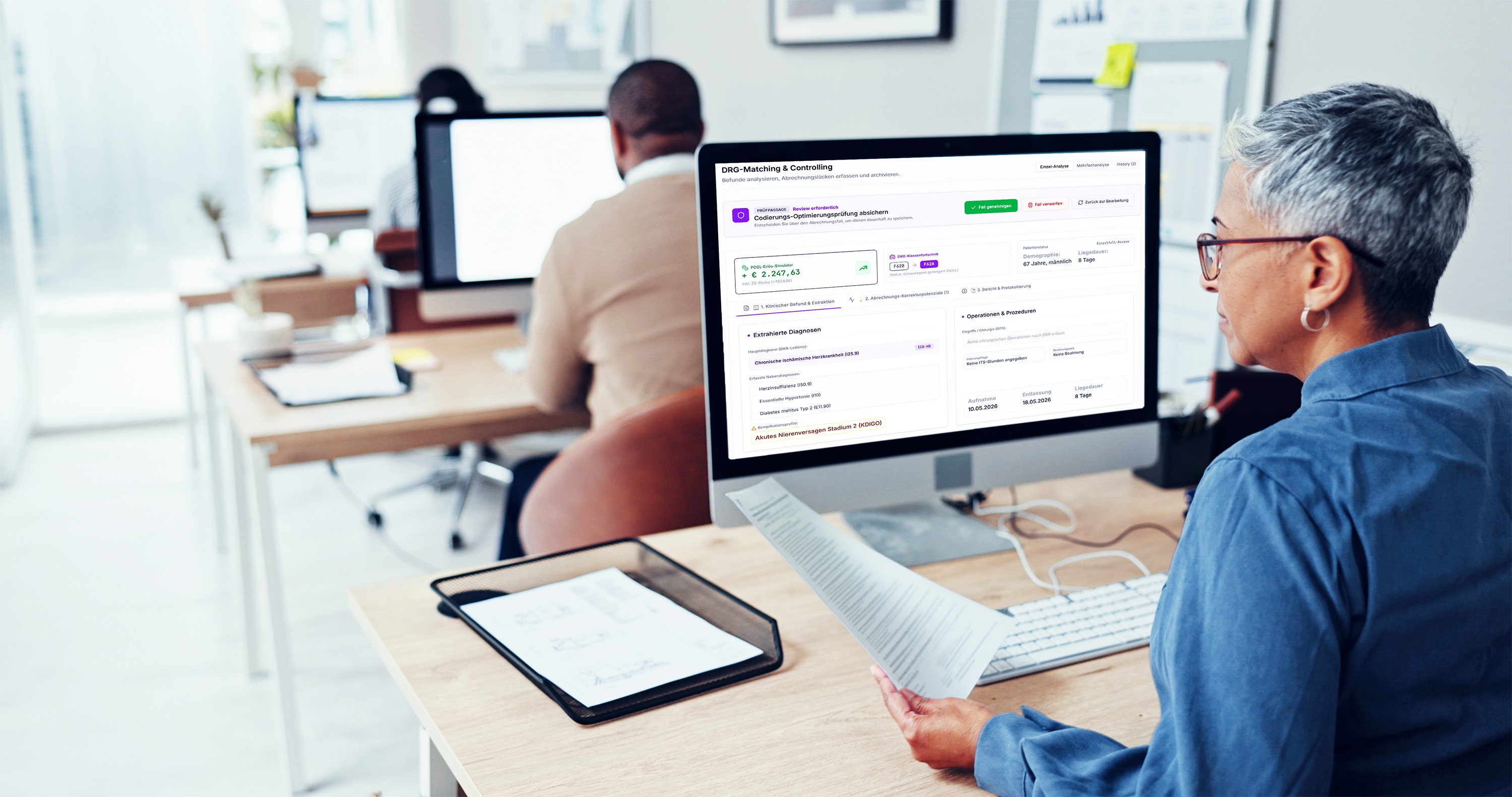
With Computer-Assisted Coding, it is possible to specifically support the coding process. CarByte has developed such a CAC system (Computer-Assisted Coding System) that automatically analyzes medical documentation, such as discharge letters, and compares it with current coding and billing standards.
We explain here how AI analyzes medical letters, discharge reports, and other medical documents using Large Language Models (LLM).
Where a service has been documented but not yet fully or correctly billed, the system generates a concrete suggestion.
The following is clearly recognizable:
- what is missing,
- why it is missing,
- and where this can be proven in the document.
A crucial point here is that the system supports the coding, but the final professional decision is always made by a human. Our system suggests optimizations but never bills on its own. Medical controlling checks every suggestion and decides whether to accept, reject, or adjust it. The solution thus provides assistance and highlights potential for improvement without taking away the professional judgment.
In the professional community, this approach is often referred to as Computer-Assisted Coding (CAC). Such systems support the coding of diagnoses and procedures by automatically analyzing medical documents and pointing out potentially missing ICD-, OPS-, or DRG-relevant information. Professional verification and final decisions always remain with the human.
What Are the Benefits of AI-Supported Coding in Hospital Practice?
The positive effect that supported coding can have can be seen in a practical example: A patient is treated for an internal medicine illness. In the discharge report, several comorbidities are mentioned that were co-treated during the course of treatment. In the actual billing, however, only the most obvious diagnoses appear, while the rest, although documented, were never translated into a billing code. An automated system reliably finds exactly such cases in a short time, preventing them from being lost in the demanding everyday life of the clinic.
For hospitals, supported coding brings three advantages:
More revenue for services already rendered, without treating more patients or
coding things differently than is medically justified.
Less time pressure in medical controlling because the team can concentrate on cases where a review is truly worthwhile, instead of having to treat every case the same.
Traceability and better preparation for audits by the Medical Service, because every suggestion is backed by clear proof from the documentation from the very beginning.
Why We Take This Seriously, Even Without Having Studied Medicine
CarByte stands behind this solution primarily with system and process knowledge. We are not medical professionals. But we understand how documentation is created, how it is translated into billing, and where things typically get lost in the process. Out of this understanding of data processing and process optimization, a useful solution was born that supports without taking over the important decisions.
The revenues lost through insufficient coding are not new revenues, but are already contained in the work performed in the hospital every day – they are simply not made fully visible. Supported coding closes exactly this gap and helps clinics secure the complete reimbursement they are entitled to.
Takeaways
Incomplete coding regularly leads to the situation where hospital services that have already been provided and documented cannot be fully billed.
Computer Assisted Coding automatically analyzes medical documents and identifies potentially missing ICD, OPS, or DRG-relevant information for billing.
AI supports medical controlling in case reviews, while the professional evaluation and final coding decision remain with humans.