
Gray Online Services
eCall Services & Gray Online Services
What are the Gray Online Services?
The Gray Online Services (G.O.D.) refer to a collection of safety-relevant online vehicle services. Unlike colorful infotainment applications such as music streaming or weather services, the G.O.D. are functional and often safety-critical. They range from convenience topics like transmitting mileage or the status of a door to services that intervene directly in the vehicle in an emergency or transmit vital information. Alongside the automatic emergency call (eCall), services such as Remote Vehicle Status, Remote Vehicle Tracking, Alert Services, Fleet Data, Remote Trip Statistics, Car Finder, and even online appointment booking are included in the G.O.D.
The “gray” services differ from the colorful entertainment services not only in color but also from a technical standpoint. They run via a highly secure backend and are subject to strict requirements for data privacy, availability, and reliability.
As CarByte, we are directly integrated into the world of G.O.D. Our main tasks are split into two subcategories – the "Call Services" (CS) and the "Enabler & Remote Services" (ER). Within the "Call Services," we deal with the requirements and development of the upcoming eCall, the Next Generation eCall (NG eCall), as well as conducting functional tests of the Gray Online Services. Additionally, the "Enabler & Remote Services" deal with vehicle registration, service management with data transmission, token acquisition between vehicle and user, as well as handling the topic of privacy.
The eCall: Invisible Lifesaver
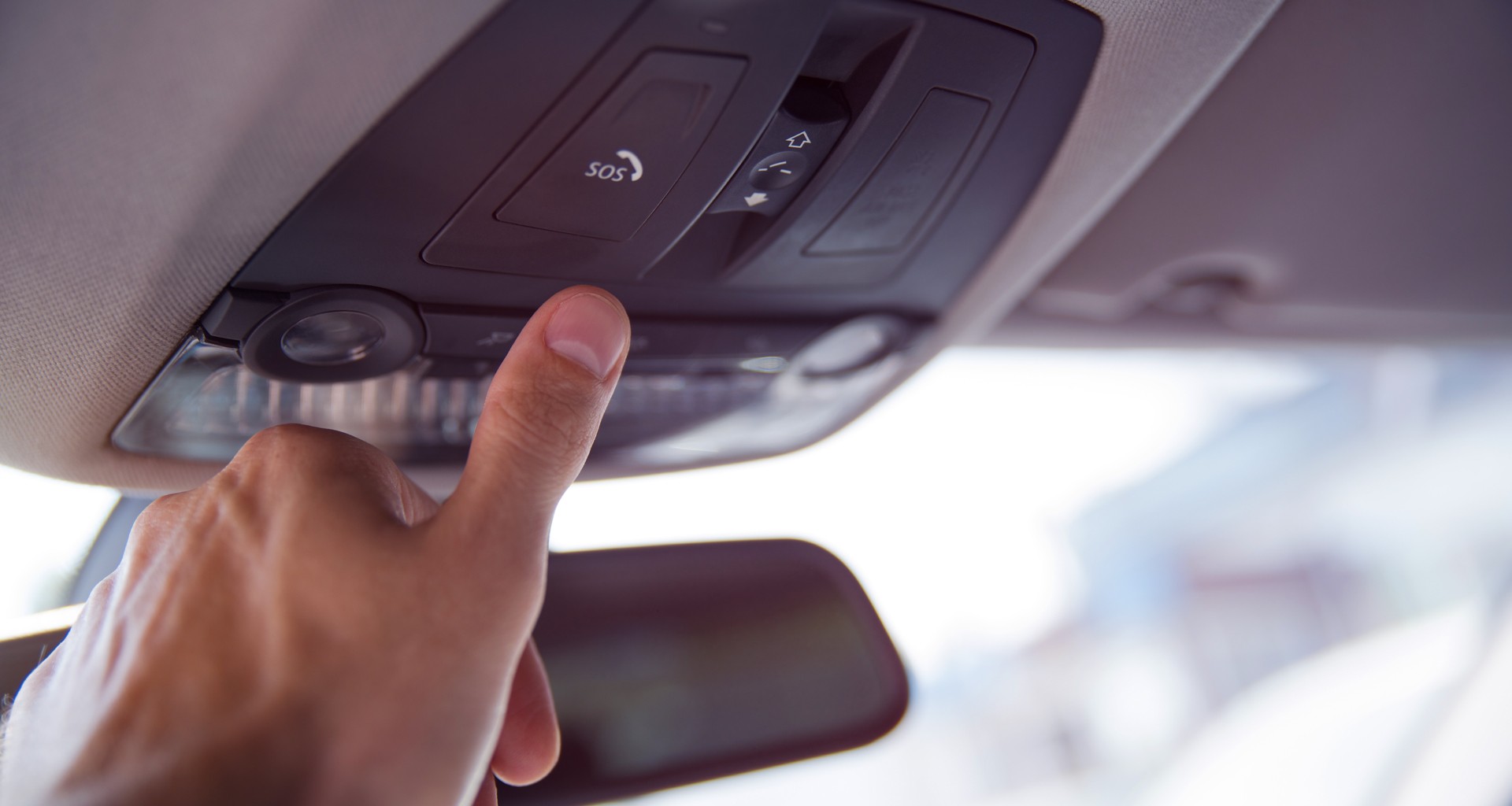
Quiet, invisible, and yet a lifesaver – the eCall. When a vehicle crashes, every second counts. This is exactly where eCall comes in, an automatic emergency call system that can save lives in critical moments. Since March 2018, eCall has been mandatory for all new vehicle types in the EU. But what many do not know: the system is only one part of a complex digital ecosystem working reliably in the background. This includes the Gray Online Services.
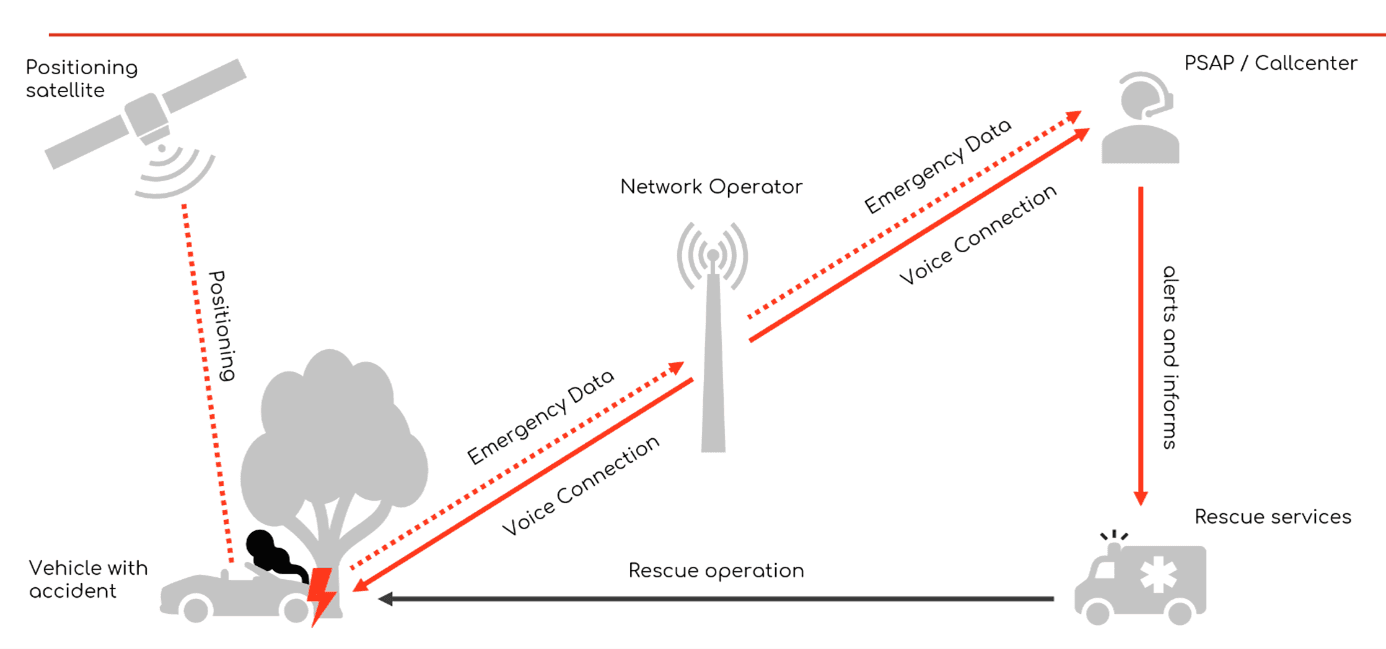
In the event of an accident, the vehicle detects certain parameters such as the impact angle or the severity of the collision and automatically triggers an eCall. A voice connection to the nearest emergency call center is then established via a mobile connection – in parallel, important vehicle data, the so-called Minimum Set of Data (MSD), such as location, direction of travel, speed, and number of passengers, is transmitted. This information helps emergency services respond faster and more targeted.
For many, the eCall remains hidden – a system that ideally never becomes active, but in an emergency can make the difference between life and death. And precisely this invisible functioning must be reliably guaranteed for years – technically, functionally, and based on regulatory requirements.
Requirements for the NG-eCall
The classic eCall is not the end of development – on the contrary: the next level is on the horizon with the NG-eCall. This relies on new mobile communications standards such as 5G, IP-based communication, and expanded data packets. The goal is not only to speed up rescue operations but also to provide more contextual information, such as about the status of the vehicle or the surrounding situation.
Functional Testing of the eCall
As part of vehicle development, eCall systems must be tested under real conditions. This means: we check whether the emergency call is triggered correctly, whether all vehicle data is transmitted, and whether the connection to the emergency call center is reliably established. Furthermore, the individual components of the control unit architecture are tested to ensure full functionality there as well.
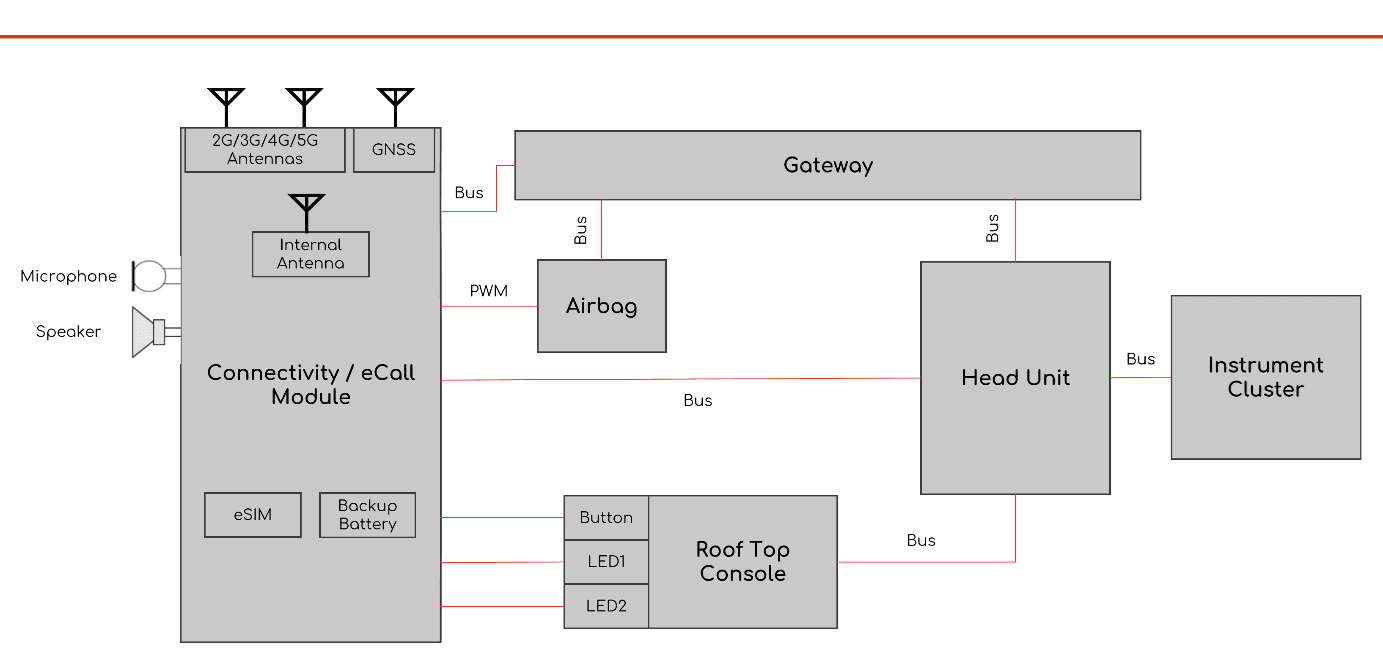
These tests take place both virtually in test environments and physically in real vehicle situations – for example, in special crash-test scenarios or using so-called "trigger tools" that simulate an accident. These test drives are carried out by our team worldwide to ensure the functionality of the system.
In doing so, we meticulously document every single test case, analyze deviations, and work closely with developers, backend specialists, and emergency call centers. Our goal: no error must go undetected, because in an emergency, every piece of information counts.
The Infrastructure Behind the (NG-)eCall
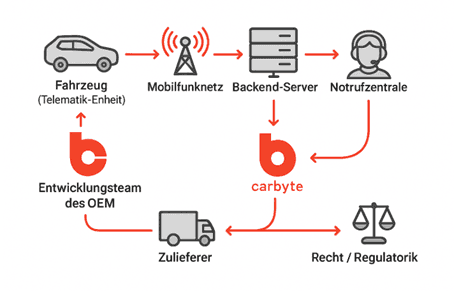
For the eCall and the G.O.D. to work, an entire ecosystem is necessary – from the telematics unit in the vehicle to the mobile network and the backend server that processes, saves, and forwards the data. This infrastructure must be available 24/7 and operate with absolute reliability.
System failures can have severe consequences, not only with regard to data privacy but also regarding the physical safety of the vehicle occupants. Therefore, regular testing, auditing, and safety analyses are an integral part of our work at CarByte.
More than Just Technology
Thanks to our broad team of experts in the individual fields, our motto is "Everyone helps everyone." This enables us to answer and solve all questions and issues surrounding the Gray Online Services in the best possible way.
The Gray Online Services are not the features you think of first when talking about modern vehicle development, and yet they are among the most important and indispensable elements of modern automotive technology. They connect human and machine, simplify our everyday lives, and alert emergency services in fractions of a second in an emergency. For that, they must function absolutely flawlessly.
Takeaways
Gray Online Services (G.O.D.) are safety-relevant vehicle online services such as eCall, Remote Vehicle Status, or tracking, which are operated reliably and securely in the background.
Gray Online Services are based on highly secure backend systems and meet strict requirements for data protection, availability, and functionality, as they sometimes directly intervene in vehicle functions.
CarByte is involved in development, testing, and further development (e.g., NG eCall with 5G) and ensures through extensive testing that these systems function reliably in an emergency.