
Gray Online Services
Hands-On Automotive eCall Testing: Setup and Insights into a Modern Test Environment
Requirements for Modern eCall Systems
The requirements for modern eCall systems have increased significantly in recent years. While the mandatory EU eCall initially represented primarily a regulatory task, emergency call architectures with NG eCall, hybrid implementations, and regional variants such as ERA-GLONASS are increasingly developing into complex, IP-based communication systems. For automotive manufacturers and suppliers, this means that without a realistic test infrastructure, conformity, interoperability, and system stability can hardly be ensured.
Structure of the Test Environment
CarByte provides a comprehensive test environment for this purpose, with which eCall and Call Service scenarios can be simulated and validated under realistic conditions. The goal is to offer OEMs and suppliers a secure, reproducible, and practical testing basis for development, pre-series, and homologation phases.
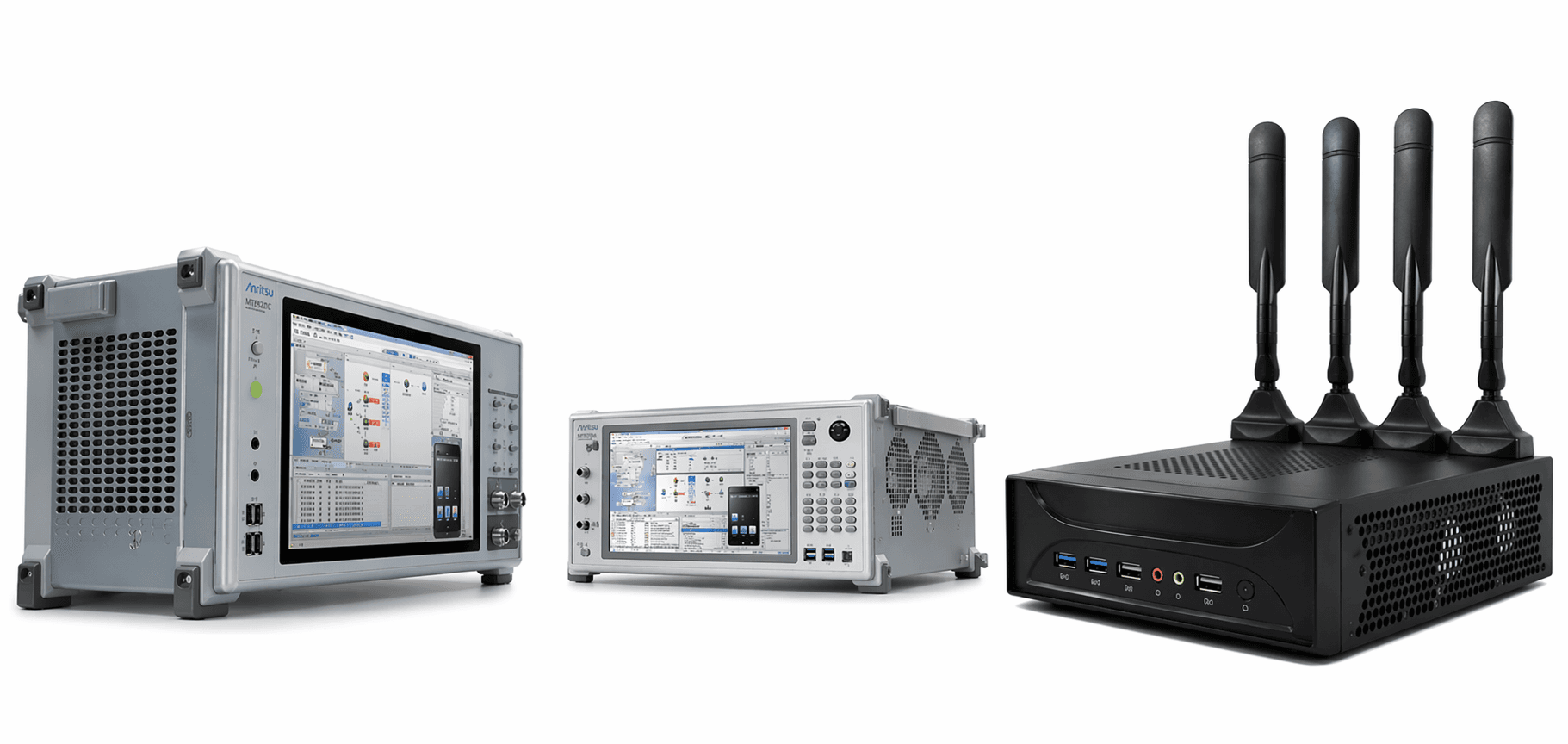
ANRITSU MD8475B Emulator for Mobile Network Cell Simulation
A central element of the infrastructure is the ANRITSU MD8475B simulator. With this system, complete mobile network cells in 2G, 3G, and 4G frequencies can be simulated. In combination with an ANRITSU PSAP simulation, EU eCall, ERA-GLONASS, NG eCall, and Private SOS Call Center scenarios can be tested realistically. Particularly relevant here is the transmission of the Minimum Set of Data (MSD), both classically via in-band and – with NG eCall – IP-based via SIP. This allows complete call flows to be tested: from call setup to MSD transmission, through to callback mechanisms and targeted error scenarios in the network.
Amarisoft Call Box Mini for 4G and 5G Networks
Another component of the test environment is the Amarisoft Call Box Mini. It allows independent 4G and 5G networks to be set up and, in particular, NG eCall SIP flows to be analyzed in detail. Although a fully-fledged PSAP is not integrated here, essential functions can be triggered and verified via traces and console commands – for example, MSD transmission via SIP Invite, MSD Requests via SIP INFO, call setup, or callback scenarios. Especially in the area of Disaster Warning Testing for the Australian market, this infrastructure offers significant potential, as warning mechanisms and network-side triggers can be evaluated under controlled conditions.
Expansion of the Test Environment: Shielded Box
For reproducible and interference-free testing, CarByte also operates three Shielded Boxes. A larger version is intended for extensive setups such as ConMod systems, while a more compact box can be used for smaller TCU setups. Both variants feature antenna connections, USB and power interfaces, and LAN, enabling stable testing conditions without external radio interference. Only under such controlled framework conditions can valid statements be made about system behavior and network interaction.
Conclusion: Secure and Comprehensive eCall Testing with CarByte
With the existing infrastructure, almost all relevant scenarios can be covered today: EU eCall, NG eCall, hybrid implementations, ERA-GLONASS, Private Call Services, and backend-integrated solutions. Furthermore, specific conditions can be simulated, such as network changes, different mobile network providers, regional frequency bands – for example, for US control units – or border-crossing situations. With structured preparation and a clearly defined test scope, the requirements for official or pre-official CTP tests in the area of all call services, but specifically in the area of NG eCall, can be established within a very short time.
In summary, it is shown that realistic eCall testing is technically comprehensively feasible – provided that mobile network emulation, PSAP simulation, SIP analysis, backend integration, and shielded test environments interlock. CarByte provides the necessary systems and corresponding expertise for this to support OEMs and suppliers in the secure validation of their eCall and Call Service architectures. Early, structured testing significantly reduces homologation risks and creates security for global vehicle programs. By using a complete test environment in the area of Call Services, a high number of errors can be detected and resolved in advance and during ongoing development. Furthermore, an initial evaluation and supplement to test drives carried out later in the development cycle in the respective countries can be conducted. Through the acquisition of the technical equipment described in this article, the existing portfolio of CarByte could be expanded in addition to the already available 4G / 5G lab: 4G/5G Mobility Lab: Comprehensive testing possibilities for mobile network technologies - CarByte - Technology Solutions for a driving digital future.
With the present setup, test automation can also be realized and has already been successfully implemented. A further, more detailed article and field report on this topic will follow. With this in mind, stay tuned, more to come.
Takeaways
Modern eCall systems are becoming increasingly complex (IP-based, hybrid architectures such as NGeCall/ERA-GLONASS), making realistic test environments necessary for compliance and interoperability.
CarByte provides a comprehensive test infrastructure for this purpose, with cellular emulation (ANRITSU), 4G/5G simulation (Amarisoft), PSAP/SIP tests, and shielded boxes for interference-free, reproducible scenarios.
The goal is end-to-end, realistic testing of all call services (including EU eCall, NGeCall, Private SOS, etc.) to identify errors early, reduce homologation risks, and safeguard global vehicle programs.